
You designed something people like. You know roughly what the materials cost. Maybe you've already sold a few.
So, what should you charge for it?
For many makers, the first calculation is surprisingly simple:
“It has about $12 worth of material in it, so if I sell it for $30, I'm making $18.”
Probably not.
The material in a product is only one part of what it costs to make and sell. Your equipment costs money to own and operate. Consumables get used. Parts get scrapped. Packaging isn't free. Selling platforms take fees. And your time has value.
But there's another problem hiding inside that seemingly simple question: knowing what something costs doesn't necessarily tell you what it's worth. Those are two different questions, and understanding the difference is the foundation of intelligent product pricing.
Cost is not price
Cost is what it takes for you to create, make, and sell the product. Price is what you ask the customer to pay for it. They're related, but they aren't interchangeable.
Suppose you determine that a product costs $25 to produce. That doesn't automatically mean the appropriate selling price is $30, $40, or $50. The price also has to make sense in the market. Customers have alternatives and expectations. Your design, quality, brand, availability, service, and uniqueness can all affect what someone is willing to pay.
Shopify's pricing guidance similarly recommends understanding production costs first and then considering competitors, market conditions, and customer value when choosing a pricing strategy. Cost-plus pricing is one method, not the only method.1
Years ago, when I developed pricing software for the sign industry, I used a simple phrase:
“The value of a sign is worth more than the sum of its parts.”
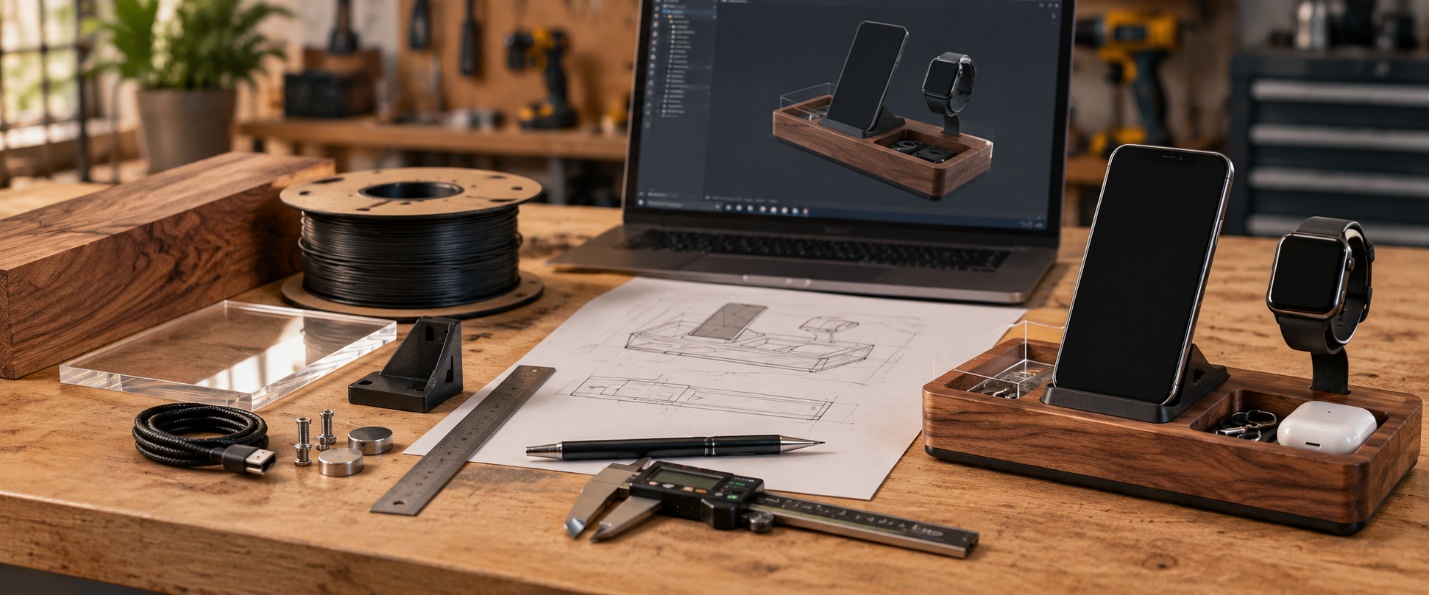
That principle applies well beyond signs. A customer doesn't really care that your product contains $8.42 of walnut, $3.18 of filament, two magnets, and 37 cents worth of fasteners. The customer cares about what the finished product does for them.
Consider a 3D-printed product made from $5.58 worth of filament that sells for $37.95. What changed? The filament didn't somehow become seven times more valuable. Someone identified a problem, engineered a solution, designed it, tested it, refined it, manufactured it, and made that solution available to someone who wanted it.
The raw material is part of the cost. The finished solution creates the value.
Three different economic questions
It helps to separate three questions that makers often combine into one:
Those aren't necessarily handled the same way. And none of them, by themselves, determines what the customer believes the finished product is worth.
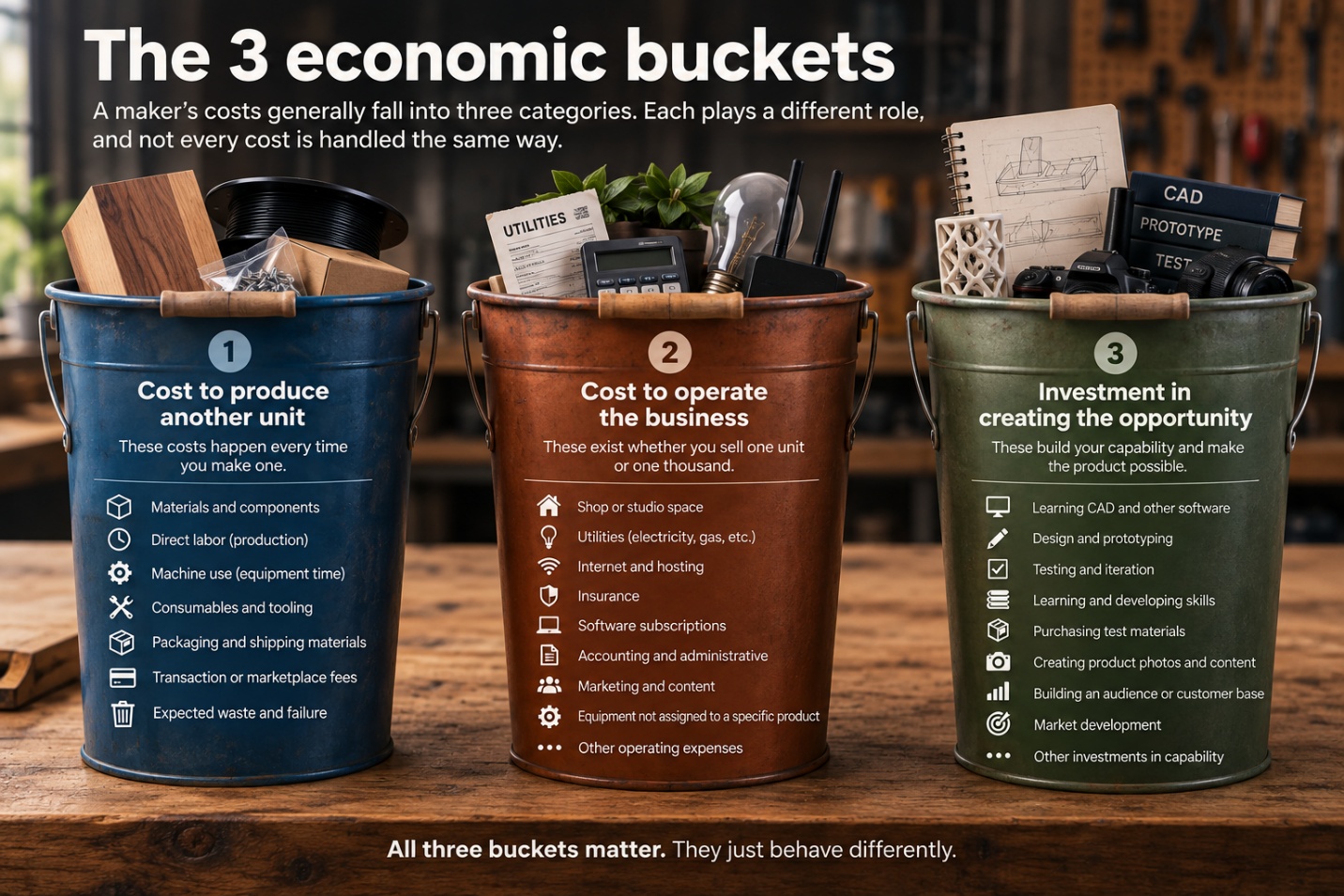
The objective here is categorization, not suggesting that every dollar in all three buckets must be recovered identically from every sale.
What does it cost to make another unit?
Economists and accountants would generally describe many of these as variable costs: expenses that increase as production increases. For a maker, these may include:
- Materials and purchased components
- Production labor
- Machine usage
- Consumables
- Packaging
- Transaction or marketplace fees
- Expected waste and failure
If you make ten units, you incur these costs roughly ten times. Understanding them establishes what it actually costs to put another product into a customer's hands.
Materials and components
Start with everything that physically becomes part of the finished product: lumber, filament, resin, acrylic, aluminum, fabric, paint, fasteners, magnets, electronics, labels, or purchased components. Use the actual quantity consumed, not simply the purchase price of the package.
If a $30 roll of material makes 20 products, the material cost is roughly $1.50 per product. If an $80 sheet of plywood yields eight usable products, the starting material allocation is roughly $10 each. Then consider waste. A saw turns some material into sawdust. CNC and laser processes leave remnants. Prints fail. Finishing consumes material that doesn't remain visibly attached to the product.
The objective isn't microscopic accounting precision. It's a reasonable representation of what production actually consumes.
Labor
Your own labor doesn't become economically worthless simply because you own the business. Etsy's seller guidance explicitly recommends establishing an hourly wage for yourself as well as employees when calculating product pricing and break-even costs.2
If a product requires 10 minutes preparing files, 15 minutes setting up equipment, 20 minutes assembling, 15 minutes sanding, 10 minutes finishing, and 5 minutes packaging, that's 75 minutes of labor. Assigning a labor rate allows you to determine whether the product actually compensates the work required to produce it.
But labor time and machine time aren't necessarily the same thing. A 3D printer might operate unattended for six hours while requiring only 20 minutes of actual human labor. Treating those six hours as six hours of labor would distort the economics just as badly as pretending the machine time is free.
Machine cost
Machines have an economic cost even after the purchase is forgotten. A printer, laser cutter, CNC router, mill, lathe, sewing machine, or other production asset may involve purchase cost, maintenance, replacement parts, consumables, electricity, repairs, and eventual replacement.
IRS Publication 946 provides a useful illustration of the underlying principle: business machinery and equipment have finite useful lives, and their acquisition cost is recovered over time through depreciation.3 Internal production costing isn't the same thing as tax depreciation, but the principle matters. Equipment ownership has a cost.
For production purposes, one useful approach is converting that ownership and operating cost into a machine cost per operating hour. That also exposes something beyond simple cost: capacity. If one product occupies a machine for eight hours and another occupies it for two, those products consume very different amounts of a limited production resource. Eventually, that makes metrics such as profit per machine hour useful when deciding what is actually worth producing.
Consumables, packaging and selling costs
Not every production expense becomes an obvious component of the finished object. Sandpaper, router bits, printer nozzles, masking, adhesives, gloves, lubricants, cleaning supplies and other consumables are real costs even though the customer may never see them.
The same applies after production. Packaging, payment-processing fees, marketplace fees, commissions, fulfillment costs and shipping subsidies can materially change profitability. The same physical product sold directly, through your own website, and through a marketplace can therefore produce different profits at exactly the same selling price.
What does it cost to keep the business running?
Some expenses exist regardless of whether you produce another unit tomorrow. These are generally overhead or fixed costs. Examples might include:
- Shop or studio space
- Insurance
- Website hosting
- Software subscriptions
- Internet
- Accounting
- Administrative expenses
- Some utilities
- Equipment and infrastructure not assigned directly to one product
The U.S. Small Business Administration uses the same broad distinction in its break-even guidance, separating fixed costs from variable costs and noting that some expenses contain elements of both.4
Overhead eventually has to be supported by the business. But it doesn't physically reside inside any particular product, which means it has to be allocated somehow. A shop might allocate overhead by labor hour, machine hour, unit produced, revenue, or some combination depending on how the business operates. The important thing is recognizing that it exists. A product that appears profitable only because rent, software, insurance, administration, and other operating expenses have been ignored isn't as profitable as it appears.
What did it cost to create the opportunity?
This third category deserves different treatment. Suppose you spent months learning CAD; learned how to operate a printer, laser or CNC router; designed 17 revisions of a product; bought test materials; built and destroyed prototypes; developed fixtures and processes; created photographs and marketing material; or built an audience. Those efforts have economic value.
But they aren't the same thing as the filament consumed by the next product you manufacture. They're investments in capability and opportunity, and investments aren't guaranteed to pay off. That matters because maker-pricing discussions sometimes drift toward the idea that every hour ever spent must somehow be charged directly to the customer. That isn't necessarily sensible.
If developing a new product requires 100 hours and you expect to sell 1,000 units, allocating some development investment across those units may be perfectly reasonable. Trying to recover all 100 hours from the first customer probably isn't. More importantly, some investments benefit more than one product. Learning CAD may enable hundreds of future designs; a better camera may support years of product photography; an audience may help sell products that don't even exist yet.
Investment creates capability, and capability creates future opportunities. Understanding what you've invested is important. Pretending every investment is a direct per-unit production cost is not.
Failure is part of production
Real manufacturing isn't perfect. Prints fail. Wood splits. Finishes get contaminated. Parts get machined incorrectly. Products get damaged during assembly.
If you make 100 units and historically lose five, the 95 good units ultimately have to support resources consumed by all 100. That's why realistic costing should account for expected waste and failure. Ignoring failure doesn't make it free. It simply hides the expense.
So what does one product actually cost?
For an individual unit, a useful conceptual model is:
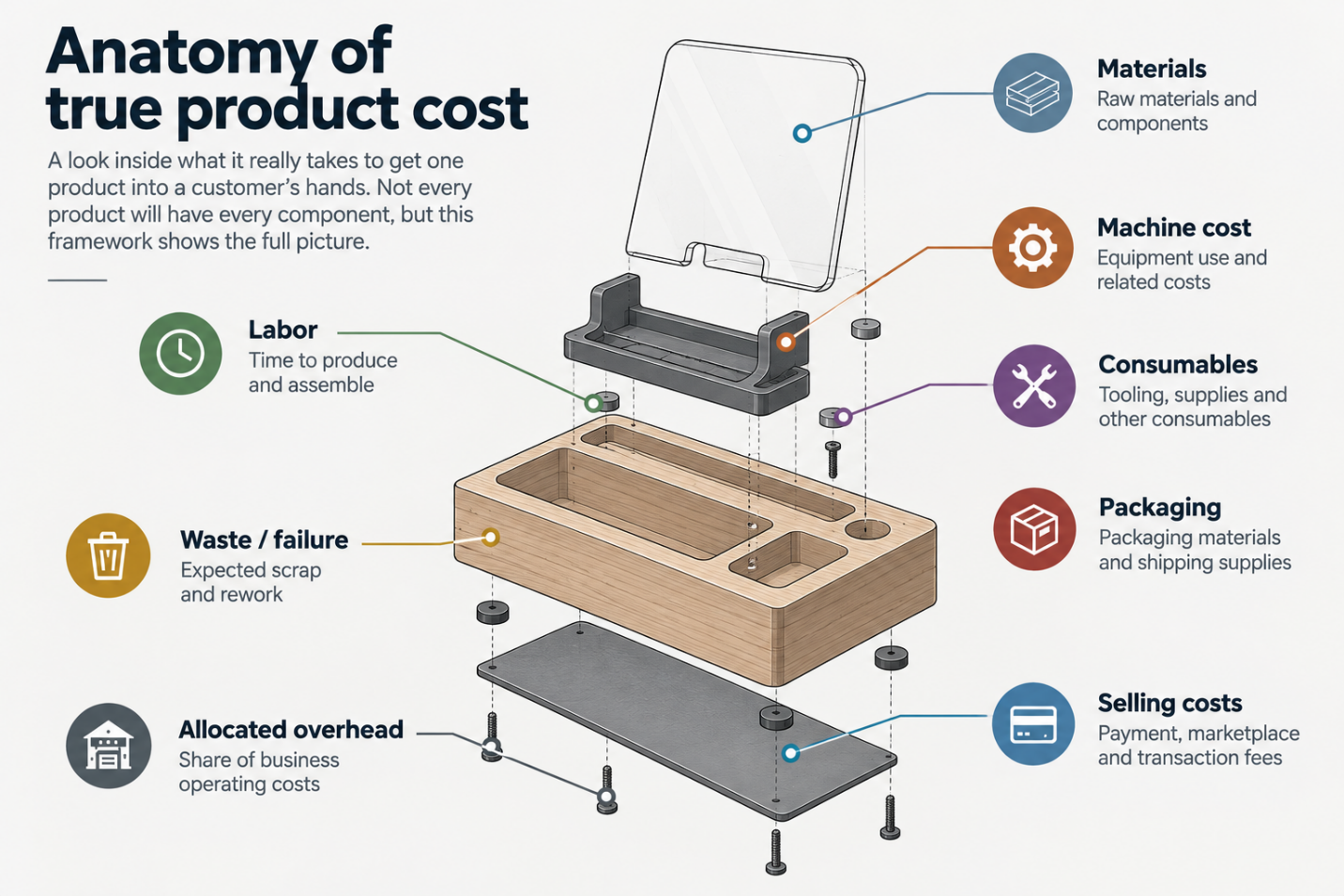
Materials + Direct labor + Machine cost + Consumables + Packaging + Expected waste/failure + Selling costs + Reasonable overhead allocation
That gives us something much more useful than material cost alone: true product cost. But we're still not finished. Knowing the true cost tells us what the product must economically support. It still doesn't tell us exactly what the product should sell for.
Cost, investment and created value
This is where pricing becomes more interesting. The maker understands the cost of producing the product and the effort and investment required to create it. But ultimately, the customer controls the value side of the equation.
A product may have required enormous effort to develop and still solve a problem nobody particularly cares about. Another may be remarkably inexpensive to manufacture while solving a problem extremely well. That difference matters.
A useful way to think about sustainable pricing is therefore as a convergence among three perspectives:
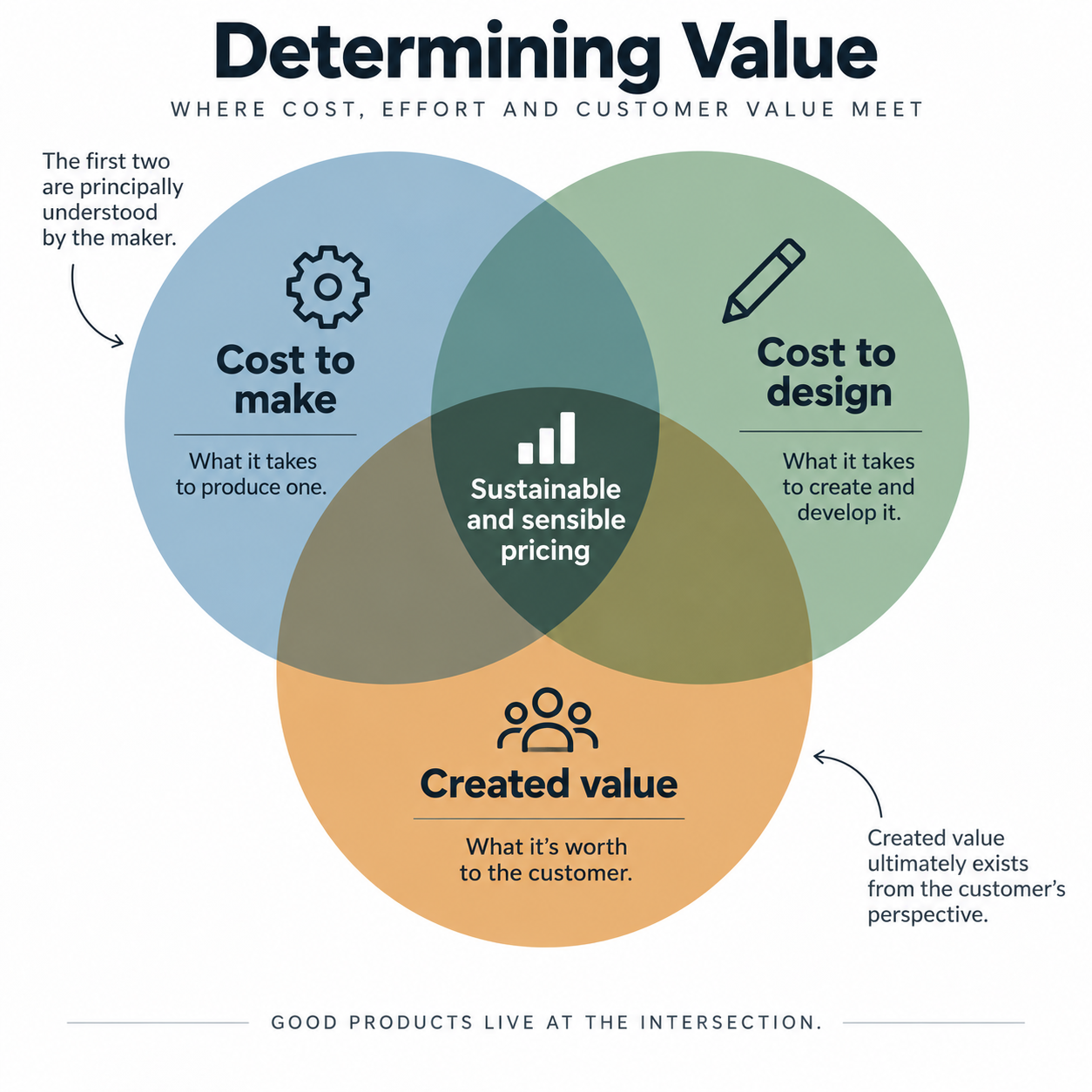
The intersection isn't a mathematical formula. It's a decision framework. Pricing isn't a science experiment where everyone using the same material and machine must arrive at the same answer. Two makers can manufacture similar products and rationally choose different prices. One may pursue volume. Another may deliberately pursue premium positioning. Another may be operating a side business that only needs to produce enough return to justify continuing. Different objectives can produce different pricing decisions.
Profit is not the same as labor
If you spend an hour producing something and assign $25 of labor to the product, that $25 compensates the work performed. Profit is what remains for the business after its costs—including labor—are covered.
Profit provides resources to develop new products, replace equipment, survive slow periods, absorb unexpected expenses, expand capacity, fund future investment, and compensate ownership for business risk. A business that reimburses its expenses and compensates the owner for production labor may provide employment. That isn't necessarily the same thing as generating a meaningful return as a business.
Markup and margin are not the same thing
Suppose a product costs $60 and sells for $100. Profit is $40.
Markup compares profit with cost: $40 ÷ $60 = 66.7% markup.
Margin compares profit with selling price: $40 ÷ $100 = 40% margin.
Same $40. Different denominator. Shopify's pricing guidance makes the same distinction: markup measures the amount added relative to product cost, while margin measures profit relative to selling price.1 Adding a 40% markup does not produce a 40% margin.
What happens when we put it all together?
Imagine a maker sells a desktop accessory for $50. The obvious material cost is $9. At first glance:
$50 selling price − $9 material = $41
That looks pretty good. Now let's look at the rest.
| Cost | Per product |
|---|---|
| Material/components | $9.00 |
| Production labor | $10.00 |
| Machine cost | $3.50 |
| Consumables | $1.00 |
| Packaging | $2.50 |
| Allocated overhead | $3.00 |
| Expected waste/failure | $1.50 |
| Selling/payment fees | $5.00 |
| Estimated total cost | $35.50 |
At a $50 selling price: Revenue: $50.00. Estimated cost: $35.50. Profit: $14.50. Margin: 29%.
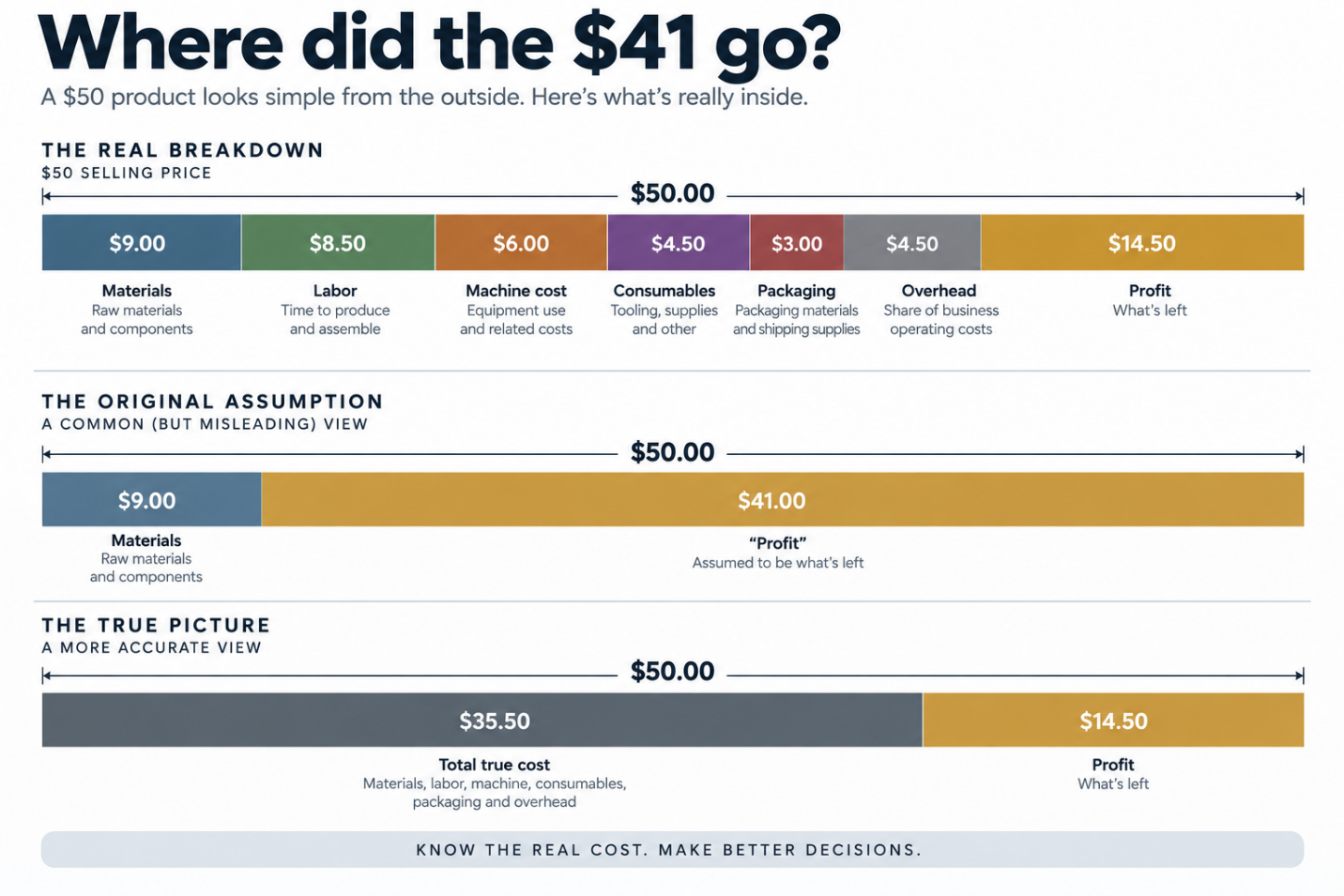
That's not necessarily a bad product. It's simply a very different economic picture from believing you're making $41.
What if the market won't support the price?
Suppose you've calculated your economics and determine that a product needs to sell for $85 to produce the return you want. Then you discover customers have several credible alternatives around $45. The calculation didn't fail. It revealed a business problem.
Perhaps your production process is too expensive; the design requires too much labor; your material choice is uneconomical; competitors manufacture at greater scale; your differentiation isn't meaningful enough; you're selling through the wrong channel; the product needs to be redesigned; or the product simply isn't commercially viable. Or perhaps your product genuinely creates enough additional value to justify a higher price. That's what you now have to determine.
Good costing doesn't tell customers what they should be willing to pay. It tells you what has to be true for producing the product to make sense.
You don't need perfect numbers
If you're just starting out, you probably don't know your exact annual machine utilization, failure rate, overhead allocation, or average consumable expense. That's normal. Start with reasonable assumptions and improve them as you collect real information.
The SBA similarly cautions that break-even calculations are estimates because some costs and production information aren't known with certainty in advance.4 An estimate that recognizes a cost exists is generally more useful than pretending the cost is zero because you can't calculate it perfectly. As your business develops, assumptions can gradually be replaced by actual data. The objective isn't perfect accounting. It's better decision-making.
Pricing is ultimately a decision
Once you understand the economics, you can start asking much better questions:
- What is my minimum economically viable price?
- What margin does this price produce?
- Am I adequately compensating my labor?
- How much profit does this product generate per machine hour?
- What happens if material costs increase?
- Can I afford a discount?
- Does wholesale still work?
- Would a faster machine improve profitability?
- How many units must I sell to recover a product-development investment?
- Which products deserve my limited production capacity?
- Does the value I create support the price I need?
Those questions are considerably more useful than: “What should I multiply my material cost by?”
From guessing to understanding
Pricing is difficult because there isn't one universal formula that produces the correct answer. But that doesn't mean the decision has to be arbitrary.
Understand what it costs to produce another unit. Understand what it costs to operate the business around it. Recognize the investments that created the capability and opportunity. Understand the value the finished product creates for the customer. Then make a pricing decision with all of that information visible.
That's the distinction between simply calculating a number and understanding the economics behind it. And that's ultimately the objective:
Know what it costs. Know what you make. Decide what's worth making.
Put the numbers to work
MakerSense IQ was built around these same principles: bringing materials, labor, machine costs, overhead, selling costs and profitability together so you can see the economics of a product in one place.
The goal isn't to have software dictate what you should charge. It's to give you enough information to make that decision intelligently.
Make sense of your own numbers
Understanding the pieces is one thing. Keeping track of materials, labor, machine costs, overhead, selling expenses and profitability across the products you actually make can get complicated quickly. MakerSense IQ was built to help make sense of it.
Use it to bring those costs together, explore your product economics, and make better-informed pricing decisions without pretending there's one magic formula that determines what you should charge.
Create a free accountSources and further reading
- Shopify — Product pricing guidance
Guidance covering production costs, pricing strategies, market considerations, markup and margin. - Etsy Seller Handbook — Product pricing guidance
Guidance discussing supplies, overhead, owner and employee labor, break-even pricing and profit. - Internal Revenue Service — Publication 946, How to Depreciate Property
Federal guidance covering depreciation and the treatment of qualifying machinery and equipment over their useful lives. - U.S. Small Business Administration — Break-even analysis
Guidance explaining fixed costs, variable costs, contribution margin and break-even analysis.